Showing posts with label ICO. Show all posts

Sunday, 12 June 2016

Does your unsubscribe work?

I have been receiving spam email, lets face it who doesn't?

So I tried to unsubscribe and the link didn't work it took me to the contact us page of the financial services company. On this page there was a complaint phone number which I called. This took me to a menu where the selections all related to credit card applications, so as well as not keen on your unsubscribing, they weren't keen on you complaining either. When I eventually got through to a human I asked to speak to their Data Protection Officer and was told they didn't have one! I asked about unsubscribing and they said they would take my details and pass them on (they weren't sure who to). Really!

Anyway while I was holding on for a person to answer the phone, I went online and reported them to the ICO for spamming me, so my time wasn't wasted ;-)

Always check that your unsubscribe function works. You don't want someone to report you to the ICO while they wait.

Make sure your staff are adequately trained and you have a named person who knows how to deal properly with the data protection queries.

Monday, 2 May 2016

How many complaints before you need to take action?

I am often asked how many complaints the Information Commissioners Office (ICO) need about a company before they start to take action. There is no definitive answer. I have known companies have as few as 12 complaints raised with the ICO before they start to make enquiries into a businesses practices. It is easy for someone to complete the online form and raise a "concern" with the ICO. When the ICO starts to investigate your practices, it can take up to six months to resolve the queries raised and receive a conclusion from the ICO as to what action they intend to take against your business.


If you are working on the basis that you won't improve your information security practices until the ICO starts to take an interest, you might not have to wait long. Data Protection is becoming more high profile and, as can be seen from the bad publicity, something that is featured in the news on a regular basis. The outcome of any investigation will depend on the type of complaint, number of complaints and the personal information involved. We regularly provide support to businesses as they go through the investigation process.

What would you do?

Sunday, 17 April 2016

Incident Trends for Data Protection Breaches


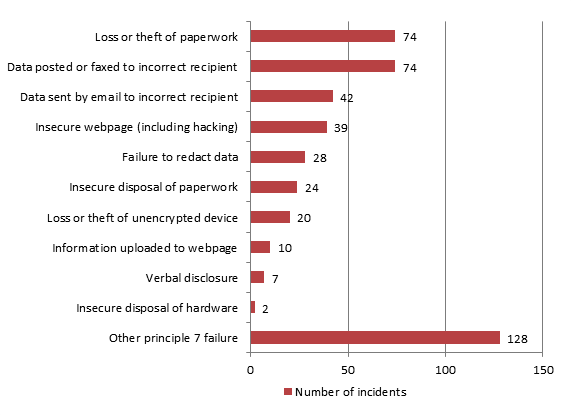
The Information Commissioners Office has published the list of ways in which personal data has been inadvertently disclosed over the last quarter. This is based on the information received by the ICO. There are undoubtedly a significant number of breaches which are never disclosed to the ICO but those that are show a definite trend.

The graph below is reproduced from the ICO website. Here's the link to the full page https://ico.org.uk/action-weve-taken/data-security-incident-trends/
 
Data security incidents by type
Top of the incidents reported is sending an email to the wrong person. Surprisingly this is followed by information being posted or faxed to the wrong person. In contrast, providing personal information verbally to the wrong person is quite low. Is this because we are more sceptical about providing information over the phone or in person to someone? The training provided by companies often focusses on this area and that may also be why this figure is so low.

The above list should be an indication to all organisations of the key areas where there is scope for losing personal information, so what steps do you have in place to make sure that information is not leaked or disclosed from your organisation in the same ways?

Sunday, 6 March 2016

Put on your dancing shoes - or not!

I have been receiving emails about dance classes for the last few months, I don't remember signing up for them and anyone who knows me will testify to the fact that I have no sense of rhythm at all.

Anyway, somehow I have been added to this mailing list for dance classes. I started receiving emails about three months ago and on average I get three a week. On occasion I have had two a day. There is no method to unsubscribe from the emails. Having got bored with receiving the emails I decided to respond to an email by asking to be removed from the mailing list. I did this on two occasions a week apart. I didn't receive a reply. The other day another email pinged into my email inbox and I decided I needed to take direct action so I rang the telephone number shown. It went to an answerphone giving me details of the classes available (Was there no escape?).

I decided I would call back again later. Just after I put the phone down, a text came in - guess what - it was a text to tell me about dance classes from the number I had just called. I was furious. I rang the number again, this time it was answered. I explained that I was very angry that I was receiving these emails and to receive a text was just too much - I had not given her permission to send me marketing by text message. The response - "Well people call me all the time wanting to know the times of dance classes so I don't answer the phone and send them a text" - really, you don't think that sending emails and the answer phone message giving information about dance classes is enough, you decide to send spam texts as well. "Nobody else has complained" (that old chestnut).

I asked about the previous emails asking to be unsubscribed and she told me she hadn't received them. I asked her to remove me from her mailing list, so I gave her my email address and she searched, only to tell me it wasn't there. I said it must be, you are sending me three emails a week on average. "Oh no that isn't possible as that would mean you were on three lists". She rechecks and finds I am on her database and on three lists (big surprise!). She said she had been hacked about a month ago and the hacker must have put me on the lists (so a hacker breaks into her email account and adds my name to three of her mailing lists so she can send me emails about dance classes, what a helpful hacker!). She tells me she cannot delete me from her database, "it won't let me". I reinforce the fact I wish to be removed from the mailing lists and how she does it is not my problem, I say goodbye and hang up. A little while later another email comes in from her to tell me she has removed me from her mailing lists but she had to remove 10 other people to be able to do it.

What did I learn?
- the dance class provider is not registered with the ICO - potentially a £5k fine and criminal record from not being registered.
- the emails she is sending breach PECR (Privacy and Electronic Communication Regulations) by not having a means to easily unsubscribe.
- Failing to remove me from her mailing list on the two previous occasions is another PECR breach.
- Sending me an unsolicited marketing text is a data protection breach - The ICO has recently fined a company £200k for unsolicited marketing texts.
- the most important thing to her was using the personal information she had gathered to further the spread of her message and the need for security and professionalism that comes from having a client list was lost on her.

If I was advising her, what should she be doing?
- Register with the ICO - a £35 annual fee
- Use a proper mailing package such as mailchimp, madmimi, constant contact etc so that she can properly manage her mailing list and those people who are desperate to unsubscribe can do so without the hassle I had.
- a proper mailing package would also be less likely to be hacked, providing she has a decent security password.
- Stop sending texts to people automatically, she is potentially raising the risk of the ICO investigating her. To be able to send marketing texts you have to have the specific permission of the individual.
- Think about the security of the information she is holding. Would she be happy with her personal information being dealt with in this way?

This is the worst case of failing to find out the requirements for running a business with a marketing list that I have come across in a while, that is unless you know better. Let me know.

Sunday, 14 February 2016

Help, it's all gone Pete Tong (wrong)! What to do when a data breach happens.

I was at a conference the other day where the speaker said that information security is low on the list of a company's priorities until it goes wrong.There was a discussion about Talk Talk and how the weakness in their cyber security was well known in IT circles. How much would it have cost Talk Talk to make the necessary changes to the system? I am guessing significantly less than the £80m it has cost them in the four months since the breach.

So what is a data breach? Simply this is when personal information ends up somewhere it isn't supposed to. The big breaches that hit the press involves lots of people's information but in smaller companies it can be as simple as a letter intended for one person being incorrectly sent to someone else, a spreadsheet of information being sent to the wrong email address or a fax being sent to the wrong number. It should not take your organisation to lose lots of information before it takes action. Each breach is an indication that there is something wrong with your systems, whether that be the actual process followed, the equipment or failing to train the individual. Learn from it.

A report by PWC shows that almost all businesses had experienced at least one data breach incident in the past year, with 90% of large organisations and 74% of small businesses reporting a security breach in the survey. In addition to the reputational damage and the cost of "fixing" the weakness, there is the disruption to the business.

The most costly breaches are malicious or criminal attacks, such as hacking.

Negligent employees are the top cause of data breaches.

In many organisations, the same personal information is available to a number of different departments, this increases the potential of a breach as more staff have access. Personal information is a valuable business asset, yet we don't always treat it that way.

So what happens when it goes wrong and there is a data breach?

Here's your basic action plan:
1 - Can you get it back? Do you know where it is and can you retrieve it?
2 - Do you know what information has been breached, who it is about and what the information was? In this case you will need to consider whether the information that has been released could cause potential damage or distress to the individual. You may then need to contact affected individuals and inform them of the breach. You may also need to contact the ICO and notify them of the breach.
3 - Investigate and remedy how the breach occurred so that further breaches are avoided. This may involve specialist advice or skills.
4 - Contact the police if applicable.
5 - Continue to update those who need to know with information about the incident.
6 - Create a policy which shows how you will handle a loss of data. This helps everyone understand what they should be doing.
7 - Train your staff in data protection compliance so they understand the importance of good data management and security.

Please remember that these are the basics, I would always advise that you seek professional advice for your circumstances. Remember you have already made a mistake by losing the information, don't compound it by not dealing with the breach correctly.

If you would like to discuss your data protection arrangements then please get in touch. 

Monday, 25 January 2016

Don’t leave your important information on the bus…


A school in York has been left red-faced after a member of the school staff left an unencrypted removable memory stick on public transport.

The Information Commissioners Office has launched an investigation after being made aware of the incident.  St Peter’s School in Clifton, which is one of York’s top public schools, admitted that there were a number of documents on the memory stick that related to school governance, and which could potentially include information about a ‘small number of individuals’ although thankfully there were no bank or financial details on the device. There was no suggestion that the information had been accessed or used by anyone since being lost in October.

The school's head, Leo Winkley, has also been forced to write to the parents of children at the school to inform them about the blunder, and is working with the ICO to make sure that all the correct procedures are followed - although it would have saved the school a great deal of trouble if they had simply encrypted their memory stick so that it was unusable without a password.
 
The loss has caused consternation in York as the device was said by a source to contain highly sensitive information about pupils and former pupils - and worryingly, the public transport operator has not been able to locate the missing memory stick - so nobody knows where it is, or whether it has been found by a member of the public and accessed.

A source told the York Press that they there had also been confusion with the ICO claiming to not know about the allegation, but after some investigation, subsequently confirmed that they were making enquiries into what had happened.

This case just underlines the necessity for all removable memory devices to be encrypted or password protected; with the best will in the world, memory sticks and other removable storage devices can go missing, but if the information is protected by a password, if it should be found by someone, the data will be protected from anyone unscrupulous using it.

Do you have a security policy in place and train your staff in how to protect sensitive information? If you’re unsure of how to protect your data, contact me and I will be delighted to provide you with guidance and advice.

Sunday, 7 December 2014

Here's how to deal with an information security breach......

We all hope that we will not be the subject of an informations ecurity breach but the chances are that all organisations will have a form of data breach at some time. Your effective response to an information Security Breach may have an impact on your company's public profile and the costs involved with the breach.
  • Have a plan. Don't wait to have a security breach before deciding what you should be doing in the event of one. Have a strategy in place that you can bring into action as and when the breach occurs.
  • Avoid Panic. Whether you are CEO, CIO, or any other senior officer, an information security breach can be alarming, but you should not panic. Evaluate the situation and decide on a plan of action as you would with any other business problem.
  • Secure the System. Take appropriate steps to contain and control the breach, to prevent further unauthorised access to or use of the personal information. You should preserve records and any other evidence. If the breach involves a lost or stolen computer or other portable media, secure any back-up files that show the information contained in the compromised system. It is helpful to make a mirror image of the records on your computer system or perform a comprehensive backup to ensure the preservation of information.
  • Organise a Response Group. You should take steps to ensure that other key members of staff and board members are notified of the information breach. Decide on a group who can make decisions to deal with the breach. the team should comprise of people who have technical expertise to deal with the situation and also who understand the nature of the information which has been breached and can advise on the information which may have been compromised or is at risk.
  • Retain Outside Advice. Retain outside advisors who have relevant expertise to help you decide upon a strategy, manage an internal investigation and comply with any notice or regulatory requirements.
  • Engage a Computer Forensic Investigator. Enlist the services of a firm specialising in computer forensics, cyber-crime response, internal investigations, and the preservation, analysis and production of electronic data.
  • Notify the relevant authorities. This should include the Information Commissioners Office if the breach is severe enough. Other organisations may include your insurer and the police depending on the type of breach.
  • Plan a Media Response. Any company which has been the subject of an information security breach should consider how they are going to deal with the press enquiries which may result. A severe breach which results in an ICO investigation will bring an interest in t the organisations which may need professional media experts to handle effectively. Any public statement should be factually accurate but reassure customers, potential customers and staff.
  • Review Your Company’s Privacy and Data Security Policies. If your company has adopted written privacy or data protection policies, review them to assess the company’s compliance with those policies in the context of the incident. Any response to the incident should be consistent with your internal policies. Also consider whether additional staff training is required to enforce the correct procedures when dealing with personal information.
  • Check Your Insurance. Check your insurance policies and other policies for potential coverage. Take the steps necessary to ensure that you do not lose insurance coverage by failing to give the required notice to the insurer or to meet any other procedural requirements. Make sure that you understand the company’s indemnity obligations under contracts with any third party involved in the incident, such as a client or vendor.
If you need any help or advice, we would love to help. Please contact me for further information at ask@audit-and-risk.co.uk

Sunday, 9 November 2014

ICO warns organisations about cyber security. Could you be at risk?

The Information Commissioners Office has suggested that organisations need to act to ensure that the information collected via their websites is secure. This is after a hotel booking website was hacked and the details of 3814 customers were accessed. You can read the full ICO comment here.

This isn't the first incident of websites being hacked for their customer details. In May 2014, Ebay was the subject of hackers and they advised all their account holders to change their password.

In April 2012, the British Pregnancy Advise Service website was hacked the name and logon details of the administrator leaked. At the time the ICO said “Ignorance is no excuse. It is especially unforgiveable when the organisation is handing information as sensitive as that held by the BPAS. Data controllers must take active steps to ensure that the personal data they are responsible for is kept safe."

Ernst and Young have researched cyber attacks and produced a report. Ernst and Young report. Cyber threats are regularly reported in the media and this indicates that attacks are becoming more sophisticated and persistent. If your organisation has not experienced an attack yet, it will no doubt be targeted.

PWC reports that cyber attacks have increased 41% over the last year and the report shows that most attacks are undertaken by a current employees.

Both the PWC and Ernst and Young report are interesting and show the importance of ensuring appropriate security and policies are in place.

If you would like some help identifying any potential weaknesses, please contact me at Lesley@audit-and-risk.co.uk. I shall be happy to help.

Sunday, 21 September 2014

Are you protecting your customer information?

One of the most valuable things a company has is its information on customers and clients. Most businesses have information about past customers but also a potential pool of future customers through a mailing list.

So you have details which are valuable to your business but how secure is that information?

Can a member of staff download your customer database onto a memory stick?

Would you know that it had happened?

Can a member of staff email your database to themselves or someone else?

The ICO can prosecute staff who send emails containing personal information. A paralegal was sending emails to himself containing personal information about clients before he left one law firm to join another, the ICO prosecuted.

A car rental manager was prosecuted for selling information about customers, who had an accident, to a claims company. The car rental company picked up an irregularity and reported it to the ICO.

People are concerned about the security of their information and want to do business with organisations that hold their information securely and don't share it with other organisations. Do you systems ensure that your customer information remains yours and you know who has access to it at any time?

If you are concerned about your data security contact me at Audit & Risk Professionals and I will be happy to talk you through how we can help.

Sunday, 27 April 2014

Should you be registered?

The Data Protection Act came into existence in 1984 and was updated in 1998. It is a complex piece of legislation with lots of requirements to it, not the easiest read! The legislation has therefore been about for 30 years so pleading ignorance about it's requirements isn't really going to be a defence.

So do you need to register with the Information Commissioners Office (ICO)? If you keep personal information for anything other than producing accounts, then the answer would be yes. For example, if you have a mailing list, then you need to register. If you have client records other than needed for accounts information, then you need to register. If you keep health information about clients, then you need to register. There are a whole host of professions which should be registered.

There is a simple assessment tool on the ICO website which will help you identify whether you need to be registered or not. http://ico.org.uk/for_organisations/data_protection/registration/self-assessment. Registering will cost you £35 and has to be updated annually.

Failing to register is a criminal offence and you can be prosecuted. Recently Becoming Green UK were fined £597 for not being registered and the business owner was also fined £597 and convicted for allowing the company to unlawfully process personal data without notifying with the ICO (section 61 of the Data Protection Act). In total, failing to register cost the owner £1194 and a criminal record, in addition to the bad publicity that has been incurred.

Clients are getting more sensitive about how their information is collected and used. Companies that take care of the information, explain how it is being used and provide detail as to how it is being shared are more likely to be respected and receive repeat business.

If you want to have a discussion about being registered (or not), contact me at lesley@audit-and-risk.co.uk or phone me on 07828 124588.